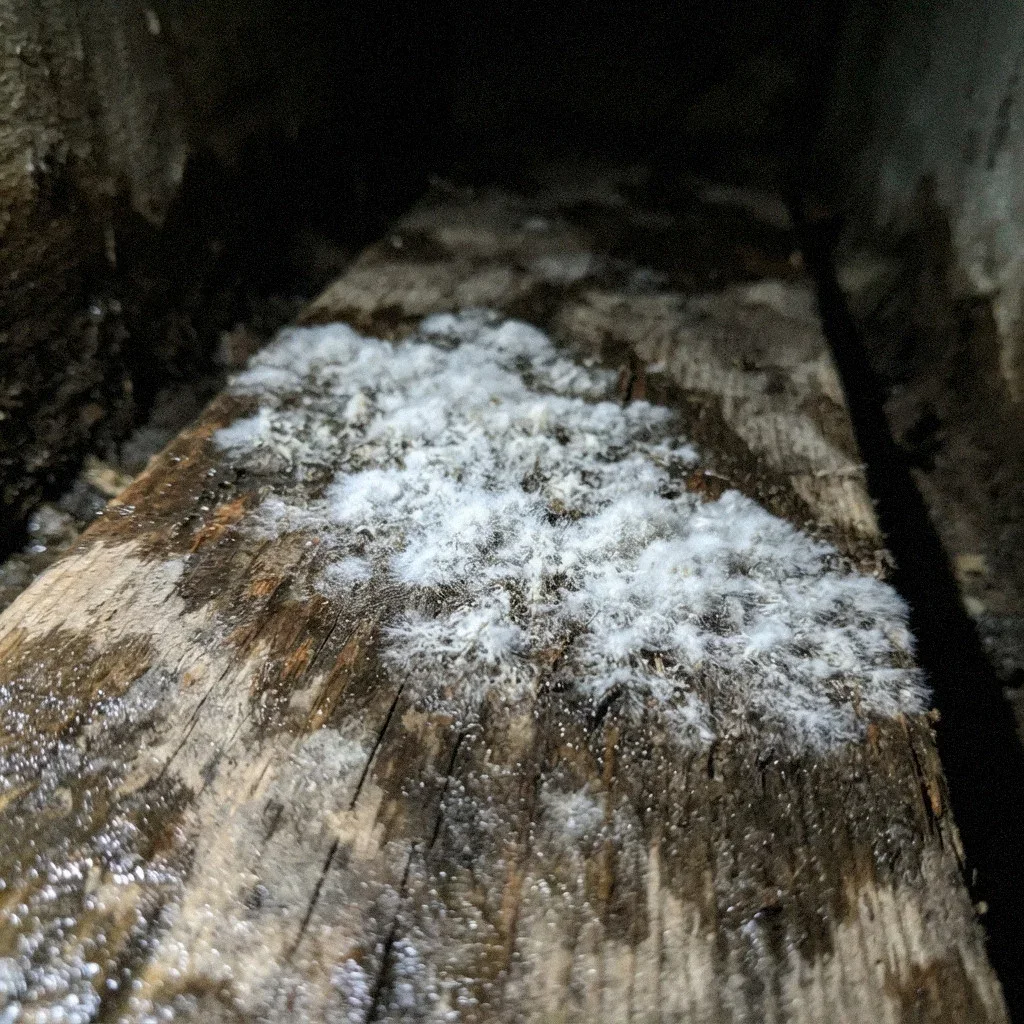
Mold and Your Health: What the Evidence Actually Says in San Diego, CA
What respiratory and allergic research actually shows, why no safe exposure level exists, and what that means for testing.
Dampness indoors is linked to asthma symptoms, allergic reactions, and irritation, especially for people already sensitized. No health authority sets a safe exposure level for indoor mold, so no test can confirm your air is safe. Symptoms are a reason to find the moisture source, not a diagnosis.
What the Research Actually Links
Mold shows up in San Diego homes without a flood, a leak, or a single memorable event behind it. A bathroom with no working extractor fan, a window in Ocean Beach or Pacific Beach that fogs from marine air every night, a crawl space under a 1950s house in Clairemont that never fully dries: each one is a slow, steady moisture source, and mold does not need much of a source once it has enough time. Understanding that mechanism matters more than knowing what mold is called.
The reason San Diego is worth treating as its own case is that the usual mold story, built around heavy rain and cold winters, does not apply here. There is no frozen pipe bursting in a wall in Kensington, no basement filling with water in North Park. The moisture comes from persistent coastal humidity and everyday water use, not storms. A house near the Pacific Ocean in La Jolla or Point Loma can carry damp air on a clear, dry day.
None of that changes what actually grows mold: an organic surface, and moisture sitting on it long enough. Drywall paper, wood framing, dust on a closet shelf near an exterior wall in Talmadge or Del Cerro are all organic enough. The building always supplies the organic material. The only variable a homeowner can do anything about is the moisture, which is why every section below keeps returning to where the water or the humidity is actually coming from.
Who Is More Vulnerable
The health question people search for is usually some version of: is this dangerous. The honest answer is narrower than either a reassurance or a warning. Indoor mold exposure is recognized as associated with asthma symptoms, allergic reactions such as hay fever, and general respiratory irritation, particularly for people who are already sensitized, have existing respiratory conditions, or are very young or older. That is the extent of what is established, and it applies whether the house is in Golden Hill or Rancho Bernardo.
What is not established is any dose that counts as safe. No federal or state authority publishes a safe exposure level for indoor mold, and none quantifies the health risk from a given amount of dampness or growth in a building. That single gap is why nobody, including a lab, can look at a sample and tell a homeowner in Serra Mesa or University Heights that their air is fine. There is no line to measure against, so a result cannot be read as a pass or a fail.
- Asthma symptoms are the most consistently reported association with damp indoor spaces, including flare-ups in people who already have the condition rather than new cases appearing from nowhere.
- Allergic-type reactions, including symptoms similar to hay fever, are reported in damp buildings, particularly by occupants who already carry sensitivities to airborne triggers.
- General irritation of the eyes, nose, throat, or airway is reported around visible dampness, without that irritation pointing to any specific species or diagnosis.
- Children, older adults, and anyone with an existing respiratory condition are described as more vulnerable to the effects of damp indoor environments than a healthy adult occupant.
- None of these associations amount to a measured dose-response relationship; they describe a pattern seen in damp buildings generally, not a specific mold-caused illness.
- A homeowner in South Park or Golden Hill noticing symptoms should treat that as a prompt to inspect for moisture, not as evidence pointing to a particular cause.
Why There Is No Safe Number
That gap is also why testing is not the tool most people expect it to be. A lab can sometimes confirm that a sample contains mold, but confirming that does not tell anyone whether the amount present is a health concern, because no exposure limit exists for it to be compared to. If a homeowner in Normal Heights or City Heights can already see growth on a wall or smell it in a closet, a test adds a lab fee without adding usable information about safety.
Testing has a narrower, more useful role: distinguishing hidden growth from a suspected but unconfirmed source, or checking a space after work is done where nothing is visible either way. It is a tool for uncertainty about presence, not a tool for certainty about safety. Somebody in Mira Mesa or Linda Vista deciding whether to test should ask what specific question the result would answer, not whether it will tell them the air is clean, because that is not a question a test can answer.
- No federal or state agency publishes a number for how many spores per cubic foot of air is safe. That absence is not an oversight; it reflects how little is standardized about measuring indoor mold exposure.
- Without a published limit, a lab report showing spore counts has nothing official to be compared against, so a homeowner near Balboa Park cannot use a number alone to decide whether their air is fine.
- Visible mold growth is generally treated as something to address regardless of what any air sample would show, since the presence of growth is itself the signal that moisture is present.
- This gap is why guidance from bodies like the California Department of Public Health centers on moisture control rather than air quality thresholds for mold specifically.
What a Lab Report Tells You
Symptoms sit in a similarly narrow place. A cough that gets worse at home, eyes that itch in one particular room, a child's asthma flaring more on some nights than others: these are reasons to go looking for a moisture problem in the house, not a diagnosis of what is causing them. Plenty of things unrelated to mold cause the same symptoms, and only a doctor can sort that out for a specific person, not a description of a house in Kearny Mesa or Bay Park.
What symptoms can reasonably prompt is a search of the building: behind furniture pushed against an exterior wall, under a sink, in a bathroom that has never had a working extractor fan, along a windowsill in a coastal neighborhood like Bird Rock or Mission Beach where condensation collects overnight. Finding a moisture source there does not confirm what is causing anyone's symptoms. It simply means there is a problem worth fixing regardless of whether it explains anything medically.
| Claim | What's Established | What's Not |
|---|---|---|
| Species present | Often yes | Not a health verdict |
| Spore count | A number, at that hour | No safe threshold to compare it to |
| Indoor vs outdoor levels | A ratio | Not a pass or fail grade |
| Your symptoms | Not measured | A medical question, not a lab one |
| Source of moisture | Not shown | The thing that actually needs fixing |
Symptoms Point at Moisture, Not a Diagnosis
Color is one of the most persistent myths in how people evaluate what they find. Black mold is not a species; several different molds appear dark, and color alone does not indicate toxicity, species, or how serious a problem is. A pale patch in a closet in San Carlos can be more extensive behind the surface than a small dark patch in a bathroom in Allied Gardens. Identifying a species from a photograph or a color is not something a visual inspection can reliably do.
Bleach carries a similar myth. It changes the color of a stain because it is a strong oxidizer that bleaches pigment, and it can kill surface growth on a hard nonporous surface. On drywall, wood, or grout it does not reach or remove the growth structure sitting below the surface, so the stain can fade while the material underneath stays exactly as colonized as before. Treating the visible color is not the same task as removing what is growing.
Why San Diego Grows Mold Without Rain
What ties all of this together is the building science underneath it, which does not require a lab to understand. Moisture is the one factor a house controls; organic material for mold to use is always present somewhere in a home, whether that home sits near Mission Valley, along El Cajon Boulevard, or up in Scripps Ranch. That is why every serious look at a mold problem starts with the water, not the growth, and why a straightforward cleaning without addressing the source tends to be temporary.
None of this is meant to settle whether a specific reader has a health problem, needs a test, or needs a specific repair; a guide cannot do that from a distance. It is meant to replace some common wrong assumptions, color included, with the two or three things that are actually established: recognized associations exist, no safe exposure number exists, and moisture is what decides whether any of it grows in the first place in a San Diego house.
What The Guidance Actually Covers
- No published safe exposure limit for indoor mold exists at the federal or state level, according to the California Department of Public Health.
- Moisture, not the availability of organic material, is the factor that determines whether mold grows in a building, since something for it to feed on is almost always already present.
- Recognized health associations with damp buildings include asthma symptoms, allergic reactions, and general irritation, with greater effect on people already sensitized.
- Older housing stock around Normal Heights and City Heights often lacks a bathroom fan that vents outside, which is a common driver of localized mold rather than any single storm or season.
- Color alone does not identify which mold is present; visual color is affected by the surface and moisture level more than by species.
- Testing indoor air for mold is generally unnecessary when growth is already visible, since there is no safe-level standard for a lab result to be measured against.
Frequently Asked Questions
Can mold in my house make me sick?
No. There is no federal or state safe exposure level for indoor mold, so a test result cannot be measured against a legal or medical threshold that does not exist. A lab can sometimes confirm mold is present in a sample from a home in places like Linda Vista or Clairemont, but confirming presence is different from certifying the air as safe, which nobody, including a testing lab, is positioned to do.
Should I get my air tested for mold?
No. Testing tells you what spores are present in the air at that moment, not whether the level is safe, because no authority publishes a safe exposure number to compare against. For visible mold in a San Diego home, finding and fixing the moisture source usually matters more than a lab result.
Are black mold species more dangerous than others?
Not reliably. Color reflects the growth conditions and the surface it is on more than the species underneath. A homeowner in Kensington or North Park cannot tell from color alone whether a patch is more or less of a concern. The moisture source matters, not the shade.
Who is most at risk from mold exposure?
The California Department of Public Health has stated plainly that no federal or state policy sets safe exposure limits for dampness and mold in buildings. That gap exists everywhere, including here in San Diego, which is why guidance focuses on removing moisture rather than chasing a number that does not exist.
Does bleach kill mold health risks for good?
See a doctor about the symptoms themselves; that is a medical question, not a building one. Separately, look for a moisture source in the home, whether that is a bathroom in Talmadge without an extractor fan or a damp crawl space in an older University Heights house. The two tracks are different problems.
Found Mold? Start With The Moisture
A guide will not tell you if your air is safe. If you have visible growth or a musty smell in your San Diego home, call (619) 833-1053 to talk it through.
Call (619) 833-1053