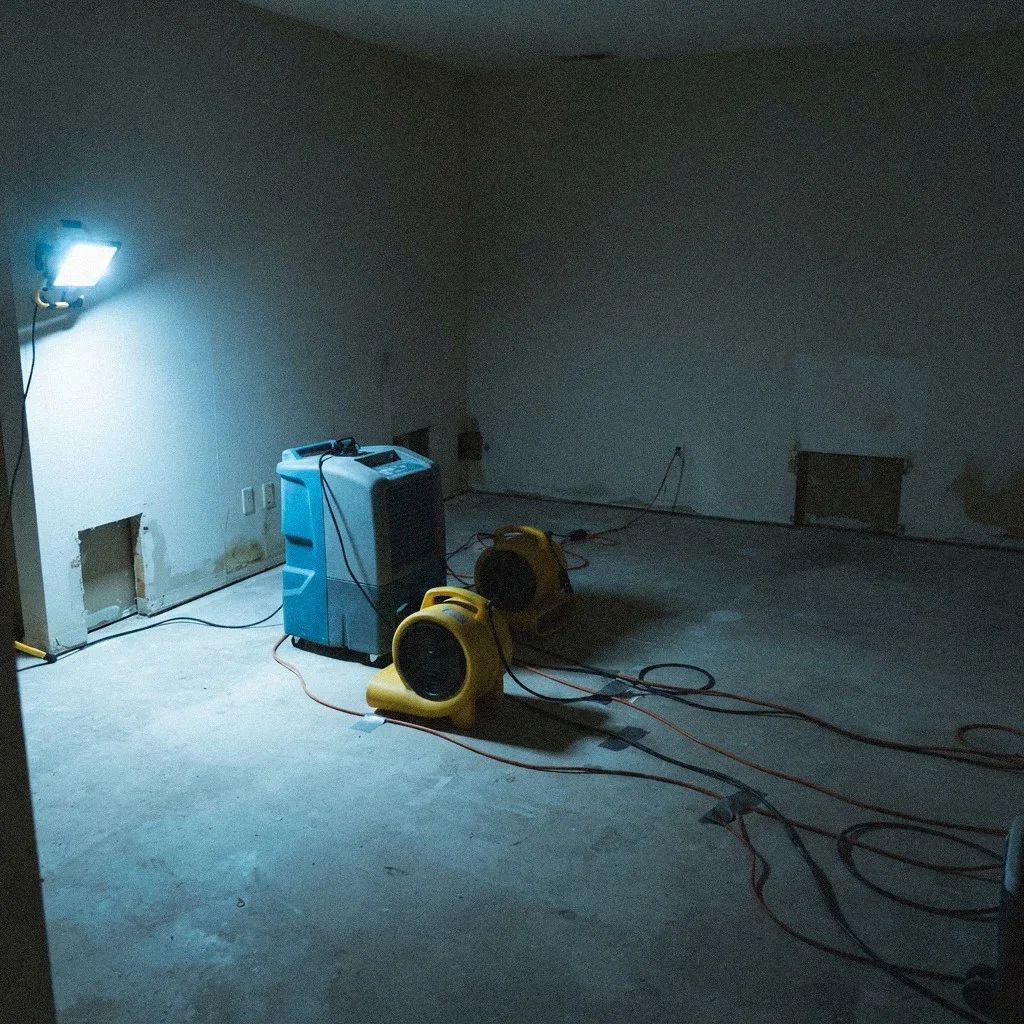
What a San Diego Mold Inspection Actually Involves
How a mold inspection and air test actually work, and why a result gets compared to outdoors, not a safe limit.
An inspection combines visual checks, moisture readings, and sometimes air or surface samples. There is no safe exposure limit for indoor mold, so lab results get compared to outdoor air or an unaffected room in the same house, never to a health standard.
Why an inspection starts with your eyes
An inspection starts with a walk-through, not a machine. The inspector looks at where water actually moves through a San Diego house: under a kitchen sink, around a window in Ocean Beach salt air, along the ceiling below a condensate line. A moisture meter checks whether a stain is active or old. Thermal imaging finds a temperature difference behind a wall that the eye cannot see. None of this requires a lab. Most visible mold is identified and dealt with on sight, and testing is added only when the visual and moisture evidence does not settle the question.
Air sampling pulls a measured volume of air onto a slide or cassette, indoors and outdoors, at the same time. The comparison is the whole point. San Diego's marine air already carries mold spores from Mission Bay, Chollas Creek and every garden in between, so an indoor number means nothing alone. What matters is whether the indoor count is higher than outdoors, or higher than a room in the same house that has no complaint. A lab that only reports one number, with nothing to compare it to, has not really told the homeowner anything.
Surface and swab sampling work differently. A swab or tape lift is pressed onto a visible patch, on drywall in a Clairemont hallway or a windowsill in Pacific Beach, to identify what is growing there rather than what is floating in the air. This tells a lab which genus is present, but it does not tell anyone how serious the exposure is, because there is no exposure threshold to compare it against. Surface sampling answers what is growing. Air sampling answers whether the air is carrying more of it than the air outside.
Reading moisture before it shows
Viable sampling grows the sample on a culture medium and counts colonies that develop over several days. Non-viable sampling counts spores directly under a microscope, dead or alive, which is faster and does not depend on whether the organism happened to be able to reproduce on that particular medium. Neither method is more correct. A dead spore can still be an allergen, so a non-viable count is not automatically the less useful number. The lab report should say which method was used, because the two are not interchangeable and a homeowner comparing two reports needs to know they were built the same way.
Reading a report means checking three things: what type of sample it was, what it was compared to, and whether the comparison point was actually a healthy reference. A report that lists a genus and a spore count but no outdoor or unaffected-room comparison is incomplete. A homeowner in Kensington or Talmadge should ask the inspector, before the sample is even taken, what it will be measured against. Without that answer in advance, the number that comes back later has nowhere to land.
- A visual inspection starts at the source, not the stain. The inspector traces the pattern back toward a window, a roofline, or a condensate line before deciding whether sampling adds anything useful.
- A moisture meter reads what the eye cannot. Pins or a pad sensor check drywall, framing, and subfloor near Mission Valley and Linda Vista homes where humid air sits against older, less-ventilated construction.
- Thermal imaging shows temperature difference, not moisture directly. A cool patch on a wall near a bathroom in North Park or South Park often points to a wet cavity worth checking with a meter.
- Air sampling pulls a set volume of air through a cassette, indoors and outdoors, then compares the two counts. San Diego's marine air already carries spores, so the outdoor number matters as much as the indoor one.
- Surface and swab sampling identifies what is growing on a specific patch, useful when discoloration on a Kensington or Talmadge ceiling could be mold, soot, or mineral staining and a visual call is not confident enough.
- Viable sampling counts live spores that can grow in a lab dish. Non-viable sampling counts every spore fragment under a microscope, living or not. Each method answers a different question about the same air.
What air sampling actually measures
There is no published exposure limit for indoor mold, in California or federally. That is not a gap in the paperwork; state guidance on building dampness and mold says outright that no policy sets a safe level or quantifies the health risk of a given count. A lab cannot tell a homeowner in Golden Hill or Normal Heights that their air tested within a legal limit, because no such limit has ever been set for anyone to test against. Any inspector who frames a number as passing or failing a safety standard is describing a standard that does not exist.
That is why every reputable comparison is relative: indoors against outdoors, one room against another. A count that is elevated compared to the air outside a house near Lake Murray or Cowles Mountain tells the homeowner something is off indoors. The same count compared to nothing tells them nothing. This is also why testing before visible mold is removed is often skipped entirely - if the growth is visible, the lab is confirming what a trained eye and a moisture meter already found, at a cost that does not usually change the next step.
- Air sampling counts spores per cubic meter of air, indoors and at an outdoor reference point, often a second sample taken outside the same Talmadge or North Park house. It does not identify a safe level; it shows whether indoor spore counts run higher than the air outside or a comparable unaffected room.
- A report lists spore types and counts per cubic meter of air, side by side for each sample location, usually the suspect room, an unaffected room, and outdoors near the property in Clairemont or Bay Park.
- An indoor count meaningfully higher than the outdoor reference for the same day points to indoor growth. A similar count indoors and out usually means the spores came in through open windows or the HVAC system.
- The species named in a report rarely changes what happens next. Cleanup addresses the moisture source and the visible growth regardless of which genus shows up on the lab sheet.
Choosing among the sampling methods
Moisture is the variable that decides whether mold grows at all, not the presence of organic material, which is always there in a house - drywall paper, wood framing, dust. A house near the San Diego River or close to Mission Bay carries humid air most of the year without a drop of rain falling, which is why inspectors here look for a source of water or sustained dampness first, before anything else. Ocean-facing neighborhoods like Sunset Cliffs or La Jolla see this pattern often: no leak anyone noticed, just marine humidity meeting a cold surface, night after night.
An older house without a bathroom fan that vents outside, common across neighborhoods built between the 1940s and 1970s, holds shower humidity against the ceiling until it condenses. A blocked air conditioning condensate line does the same thing behind a wall or inside a closet. Neither shows up as a leak. Both show up on a moisture meter as a damp reading with no visible plumbing fault nearby, which is exactly the kind of finding an inspection is built to catch before it becomes a larger repair.
| Method | What It Shows | What It Misses |
|---|---|---|
| Visual inspection | Growth, staining, moisture source | No lab needed |
| Moisture meter | Wet content inside material | Reads number, not species |
| Thermal imaging | Temperature patterns, hidden dampness | Confirms with meter after |
| Air sampling | Spore count versus outdoor air | Needs outdoor reference sample |
| Surface or swab sampling | What's growing on a surface | Direct, no air comparison |
Viable versus non-viable counts
Color is not identification. A dark patch on a bathroom ceiling in University Heights and a dark patch on a garage wall in Serra Mesa can be different organisms entirely, or the same one under different light. Only a lab, working from a swab or air sample, identifies genus or species with any reliability, and even then the identification does not change how the growth is treated. What changes the treatment is the size of the affected area and whether the moisture source has been found and stopped.
This is also why testing is often unnecessary once mold is already visible. If a patch is confirmed on sight and the water source is identified, a lab report on species does not usually change the remediation approach. Testing earns its cost when the picture is ambiguous - a smell with no visible growth, a health complaint with no obvious source, or a dispute between a tenant and a landlord in a rental near San Diego State University where a documented, comparative result matters more than an opinion.
Why there is no safe number
Bleach is worth mentioning here because it comes up in almost every online search a homeowner runs before calling anyone. Bleach removes the color from a surface. It does not reliably kill growth rooted into porous material like drywall or wood framing, and it does nothing about the moisture that let the growth start. A report showing elevated mold and a source of water does not point toward a bottle of bleach; it points toward finding and stopping the water, then removing the affected material.
None of this replaces judgment on the ground. An inspector walking a raised-floor house in Mission Valley or a coastal cottage near Ocean Beach is weighing moisture readings, visible growth, ventilation, and how the house handles marine humidity without rain, all at once. Lab results support that judgment; they do not substitute for it. A report is only as useful as the comparison built into it, and a homeowner who understands that comparison walks away from an inspection knowing what the numbers actually mean.
What A Report Actually Compares
- No federal or state agency has set a safe exposure limit for indoor mold, so no lab report can call air 'safe' or 'unsafe' in a legal sense.
- Results are always relative: indoor counts get compared against an outdoor sample and against an unaffected room, never against a fixed number.
- Color is not identification. A black stain on drywall near Golden Hill or Normal Heights needs a swab or lab culture to say more than the eye already suggests.
- Testing is usually skipped when mold is already visible. Sampling earns its cost when growth is hidden, disputed, or behind a wall cavity that cannot be opened without a reason.
- A moisture reading above normal for the material, not a number on a spore count, is usually what tells an inspector where the real problem sits.
- San Diego's steady marine humidity means outdoor spore counts run higher here than in a dry inland climate, which is exactly why the outdoor reference sample matters so much locally.
Frequently Asked Questions
Do I need a mold test or just remediation?
Visible growth on a wall in North Park or a musty smell after AC service in Clairemont rarely needs lab work first — a licensed pro can assess it by eye and start remediation. Testing earns its cost mainly for hidden growth behind a wall, disputes over scope, or post-work air sampling once repairs are done.
What does the lab report number actually mean?
Not usually. If mold is already visible on drywall or tile, a lab test mainly confirms what an inspector can already see. Testing earns its place when growth is hidden behind a wall, a dispute needs documentation, or a smell has no visible source in the room.
Is there a safe level of mold spores?
No. There is no published safe level for indoor mold spores, so a report cannot say air is safe or unsafe. It can only compare the sampled room to outdoor air or to another room in the same house on the same day.
What's the difference between air and surface sampling?
Color alone. Black, green, and white growth can all be the same species or different ones; pigment depends on the surface and moisture, not the organism. A swab or lab culture is the only way to name what is actually growing.
Can a moisture meter find mold behind drywall?
A moisture meter reads elevated moisture in a wall cavity, which tells you conditions favor growth, but it cannot see the mold itself. In a Kensington or University Heights house with a hidden condensate leak, a high reading behind drywall near a bathroom or AC line is the reason to open the wall or bring in thermal imaging, not proof of growth on its own.
Wondering If Testing Is Worth It?
Not sure whether a spot needs a lab test or just a cleanup? Call (619) 833-1053 and describe what you're seeing.
Call (619) 833-1053